
Introduction
In the booming world of software-as-a-service (SaaS), one question often surfaces: “Who is the biggest SaaS company? On the surface it seems simple — just pick the highest revenue or largest market cap. But what does “biggest” really mean in the SaaS realm? And why does it matter to digital marketing agencies, freelancers and small business owners who are evaluating tools like GoHighLevel?
Table of Contents
In this article we’ll cover:
- The metrics used to measure “biggest” in SaaS
- Leading SaaS companies today and who currently holds the top spot
- What this means for you as someone evaluating SaaS tools (CRM, automation, white-label, etc.)
- Where GoHighLevel fits in the ecosystem
- Pros & cons of choosing tools from large vs smaller SaaS firms
- FAQs and a conclusion with a call to action for trying GoHighLevel
What Does “Biggest” Mean in SaaS?
Before naming a company as the biggest SaaS business, we need to clarify what “biggest” means. Here are the common benchmarks:
✅ 1. Revenue / Annual Recurring Revenue (ARR)
Many SaaS companies publicise their ARR or revenue growth. The one with the highest SaaS-specific revenue often gets labelled “biggest”.
✅ 2. Market Capitalization
For publicly listed companies, size is often measured by market cap. A company may offer many SaaS products but still be large by valuation.
For example, according to recent data, the largest software companies by market cap include major firms such as Microsoft and Apple — though strictly speaking they aren’t purely SaaS companies. CompaniesMarketCap+2Eqvista+2
✅ 3. Customer Base / Reach
Some define “biggest” by number of users, geographic reach, or enterprise customer base. A SaaS firm serving tens of thousands of enterprises worldwide may be considered large even if its revenue trails another company.
✅ 4. Product Portfolio & Scope
SaaS firms with many segments (CRM, ERP, automation, human capital, etc.) and a diverse product line can also be seen as dominant, even if a single product is not #1.
In short: measuring “biggest” is nuanced. For our purposes, we’ll look at revenue + market cap + influence in the SaaS space to identify which company stands out.
The Leading Candidates for the Biggest SaaS Company
Based on the latest market data (2025), several companies are contenders for “biggest SaaS company.” Let’s examine them.
🔹 Microsoft
Although Microsoft is a broad-based technology company, it hosts massive SaaS operations (e.g., Microsoft 365, Azure, GitHub). According to 2025 data, Microsoft is one of the largest SaaS-oriented firms by market cap and revenue. Exploding Topics+1
🔹 Adobe
Adobe made its transformation from boxed-software into SaaS with Creative Cloud and other offerings. Articles list Adobe as one of the top SaaS companies by revenue. Exploding Topics+1
🔹 Salesforce
Often cited as the pioneer of enterprise SaaS (especially CRM-related), Salesforce is frequently listed as the largest pure SaaS company (focused on SaaS rather than broader tech). For example, one list says “Salesforce is still the largest SaaS company in the U.S.” Mike Sonders+1
🔹 Other Notables
- Shopify – large e-commerce SaaS
- ServiceNow – enterprise workflow SaaS
- Intuit – finance/SMB SaaS
These companies are huge, but may not exceed the top incumbents in terms of pure SaaS revenue or market dominance.
So, Who Is the Biggest SaaS Company?
Given all the data, the safe answer is: Salesforce remains the largest pure-play SaaS company focused on cloud subscription software for enterprise customers. According to a 2020 list:
“Salesforce is still the · largest SaaS company in the U.S., with a market capitalization of $161.4 billion…” Mike Sonders
However, if you include diversified tech giants with large SaaS divisions (Microsoft, Adobe), the “biggest” title could belong to Microsoft because of its massive valuation and SaaS portfolio. The article from 2025 data shows Microsoft as one of the largest SaaS companies. venasolutions.com+1
Therefore, for clarity in this article:
- Largest pure SaaS company (focused solely on cloud software): Salesforce
- Largest SaaS-inclusive company (with broader tech operations): Microsoft
Why This Matters for Agencies, Freelancers & Small Businesses
You might be thinking: “Why should I care who’s the biggest SaaS company when I’m considering a tool like GoHighLevel?”
Here are three reasons why:
⚙️ 1. Stability and Trust
Choosing a tool backed by a large, established SaaS company can mean reliability in updates, support, uptime, and innovation.
🚀 2. Ecosystem Integration
Large SaaS firms often have rich integrations and partner ecosystems. If your marketing stack includes CRM, automation, funnels, booking, etc., the breadth of integrations can matter.
💼 3. Competitive benchmark
Seeing what enterprise SaaS companies build can inform what you should expect from your tools — for example, robust automation, pipeline management, client portals, and white-label features.
That said, sometimes smaller SaaS platforms (like GoHighLevel) can serve agencies and freelancers better because they are built for your specific use-case (agency, automation) rather than generic enterprise.
Where Does GoHighLevel Fit In the SaaS Landscape?
Now, if you’re reading this article thanks to interest in GoHighLevel — let’s connect the dots.
🛠 What is GoHighLevel?
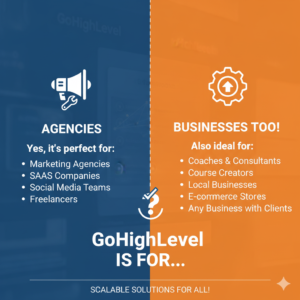
GoHighLevel is a SaaS platform specifically designed for digital marketing agencies, freelancers, and small businesses. It combines CRM, marketing automation, funnels, booking, and even white-label SaaS resale features. It allows users to build their own SaaS (through “SaaS mode”), white-label the product, automate workflows, and manage clients in one dashboard.
📌 Key Related Terms & Features
- GoHighLevel CRM – the built-in customer relationship management system
- GoHighLevel Automation – workflows, triggers, email/SMS, pipelines
- GoHighLevel SaaS Mode – ability to rebrand and resell the platform under your own brand
- GoHighLevel White Label – branding the platform as your own client-facing offering
- GoHighLevel Pricing & Affiliate – the subscription plans and affiliate program to earn recurring revenue
🔍 Why Mention the Biggest SaaS Company in a GoHighLevel article?
Because knowing how enterprise-class SaaS firms operate helps you evaluate smaller niche offerings. If Salesforce sets the standard for CRM SaaS, you can ask: “Does GoHighLevel offer comparable CRM features, automation, scalability, and white-label flexibility for agencies?”
Feature Breakdown: What Enterprises Do vs What Agencies Need
Let’s compare features you’d expect from the “biggest” SaaS companies (like Salesforce) and how those translate into agency-focused platforms like GoHighLevel.
✅ Enterprise SaaS (e.g., Salesforce)
Key features often include:
- Enterprise-level CRM with territory management, global rollout, advanced analytics
- Deep customization and developer tools
- Large ecosystem, app marketplace
- Massive pricing tiers, high cost
- Focused on large enterprises, sometimes less on marketing agencies’ needs
✅ Agency/Specialist SaaS (e.g., GoHighLevel)
Key features include:
- CRM + marketing automation + funnel builder in one tool
- Built for marketing agencies, client networks, sub-accounts
- White-label and SaaS mode built in
- Pricing affordable for agencies and freelancers
- Simplified UI optimized for marketing workflows
So, while big SaaS companies set the bar for scale and enterprise features, platforms like GoHighLevel bring those capabilities into the reach of agencies and small businesses.
Pros & Cons of Choosing a Niche SaaS Platform vs Big Player
✅ Pros of Niche Platforms (like GoHighLevel)
- Cost-effective pricing
- Tailored to agencies & freelancers
- Built-in marketing automation and funnels (not just CRM)
- White-label/SaaS resale features baked in
❌ Cons
- May lack the breadth of integrations and enterprise-grade features of a giant SaaS company
- Potentially smaller support or fewer global data centres
- If your business grows into very large enterprise size, you may “out-grow” the platform
✅ Pros of Big SaaS Players
- Proven scalability and reliability
- Broad ecosystem and third-party integrations
- Recognized brand, likely global data centres and enterprise SLA
- Strong innovation budget
❌ Cons
- Very high cost for smaller teams
- May require multiple modules and add-ons, raising complexity
- Less tailored to agency workflows (e.g., funnels & white-label may be separate tools)
Pricing Comparison & Considerations
When evaluating the best SaaS tool for your agency/freelancer business, pricing and value matter a lot.
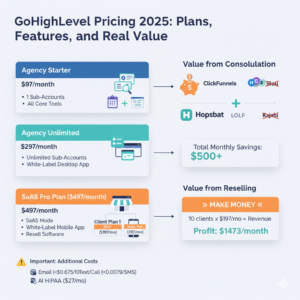
💡 GoHighLevel Pricing (2025)
| Plan | Monthly Price | Includes |
|---|---|---|
| Agency Starter Account | ~$97/month | CRM, automation, funnels, booking, etc. |
| Agency Unlimited Account | ~$297/month | Unlimited sub-accounts, white label tools |
| SaaS Mode Plan | ~$497/month | Full SaaS resale mode, branded app, billing automation |
👉 Free trial link: Try GoHighLevel Free
Comparison with Larger SaaS CRM Players
Large SaaS platforms (like Salesforce) often start at much higher pricing for full-featured enterprise modules, and additional automation/funnels may cost extra. For smaller agencies or freelancers, this can be cost-prohibitive.
What You Should Consider
- Do you need full enterprise scale, or a tool tailored to agencies?
- Does the platform include marketing automation/funnel builder, or do you need add-ons?
- Is white-label/SaaS resale part of the offering (important for agencies building recurring-revenue offers)?
- What’s your budget and growth projection?
- Will you outgrow the platform quickly?
Why the Biggest SaaS Company May Not Always be the Best Fit for You
Even though Salesforce or Microsoft may be the biggest SaaS companies, that doesn’t automatically make them the best choice for your agency, freelancer, or small business. Consider:
- Complexity and cost: Big tools may require implementation specialists, training.
- Fit for purpose: Agency-specific workflows (funnels, sub-accounts, white-label) might be missing.
- Ownership and control: White-label features may be limited on large enterprise tools.
- Speed of setup: You might prefer a tool you can launch quickly rather than a long enterprise roll-out.
Hence, sometimes the smaller or more specialized SaaS tool (GoHighLevel) may deliver more value per dollar for your niche.
Real-World Example: How an Agency Chooses Their SaaS Platform
Let’s walk through a hypothetical digital marketing agency scenario:
- Agency manages 20 small business clients.
- They need CRM, automation, booking, funnel builder and want to present a branded portal.
- They also want to offer “their own SaaS solution” to upsell clients or prospects (white-label).
Option A – Big SaaS CRM (e.g., Salesforce)
- Pros: Strong CRM, huge brand.
- Cons: Very expensive, funnel builder may be separate, white-label/resale may require custom development.
Option B – Specialized SaaS Platform (GoHighLevel)
- Pros: Built-in funnel & automation, white-label/SaaS mode, affordable for agencies.
- Cons: Slight trade-off in scale/integrations compared to enterprise CRM.
For this agency, option B may deliver better ROI, faster setup, and recurring revenue potential.
Frequently Asked Questions
Q1: Who is currently the biggest SaaS company?
As of 2025, the largest pure-play SaaS company is generally considered to be Salesforce. If you include tech giants with large SaaS portfolios, Microsoft is the largest by market cap.
Q2: What exactly counts as a “SaaS company”?
A SaaS company delivers software over the internet on a subscription basis, handles hosting and updates, and usually scales globally. HubSpot Blog
Q3: Does company size matter when choosing a SaaS tool?
Size can indicate stability and ecosystem, but fit to your use-case, cost, and features matter more for agencies/freelancers.
Q4: How does GoHighLevel compare to the biggest SaaS companies?
GoHighLevel is a niche platform optimized for agencies with built-in CRM, automation, funnels, and white-label/SaaS resale features — not the broad enterprise focus of giants.
Q5: Should I select a smaller SaaS tool simply because it’s cheaper?
Pricing is important, but ensure it meets your feature, integration, automation and growth requirements — cheaper but incomplete can cost in the long-run.
Conclusion & Call to Action
When someone asks: “Who is the biggest SaaS company?”, the quick answer is Salesforce for pure SaaS or Microsoft if you include broader tech firms. But the bigger question for you as an agency, freelancer or small business owner is: “Which SaaS platform is best for you?”
Do you need enterprise-scale or agency-focused? Do you need white-label/SaaS resale? Do you need built-in funnels and automation? If you’re leaning toward those latter needs, then a platform like GoHighLevel — designed to serve agencies and freelancers — may be the smarter choice.
👉 Ready to explore GoHighLevel?
Start your free trial today and see if it fits your agency or business model:
Try GoHighLevel Free