Introduction
If you’re a digital marketing agency owner, freelancer, or small business leader looking into SaaS opportunities, you may have come across the term “3-3-2-2-2 rule of SaaS.” It sounds catchy, but what does it really mean — and how should you apply it when you’re building a SaaS offering (for example via GoHighLevel in SaaS mode)?
In this article, we’ll unpack what the rule means, why investors and SaaS founders use it as a benchmark, and how you as an agency/freelancer or white-label SaaS provider (for example using GoHighLevel’s white-label / SaaS mode) can use it to set targets, build strategy, and avoid common pitfalls.
Table of Contents
What Exactly Is the 3-3-2-2-2 Rule of SaaS?
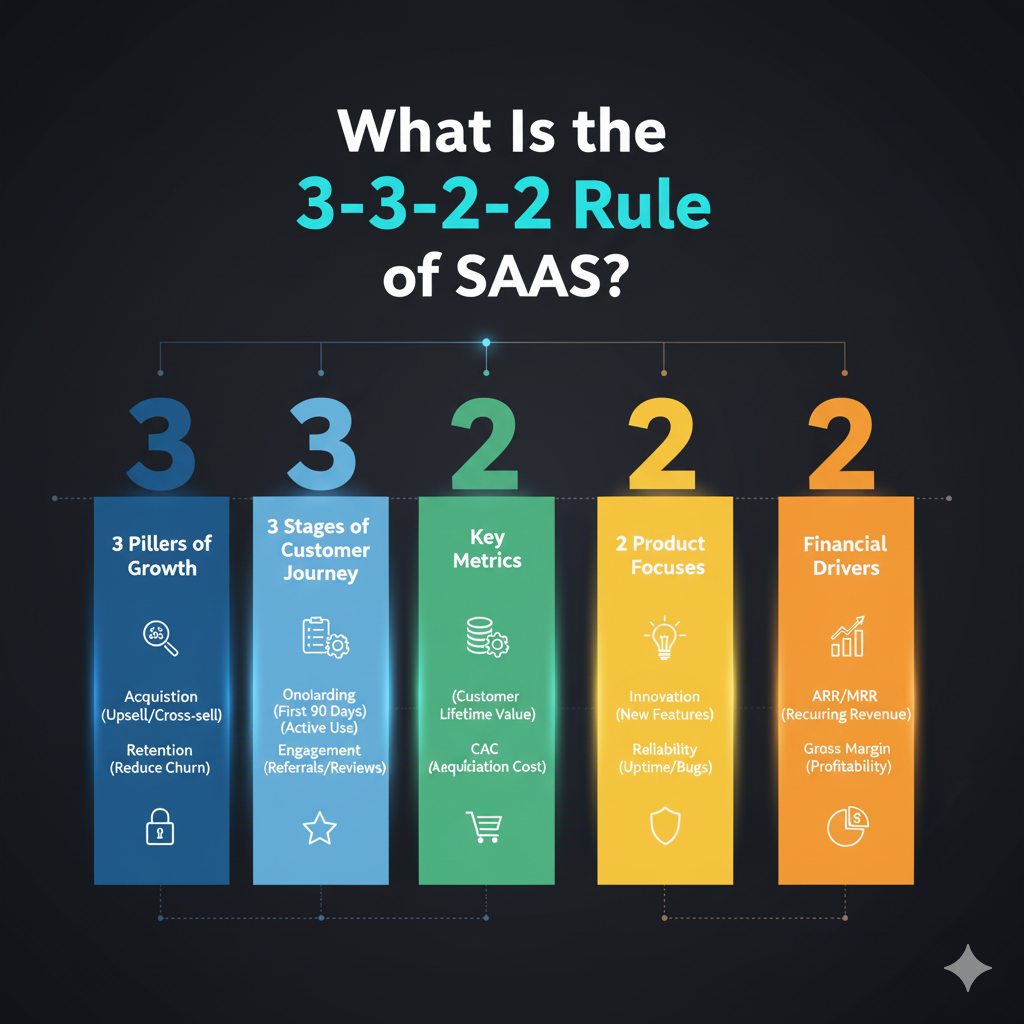
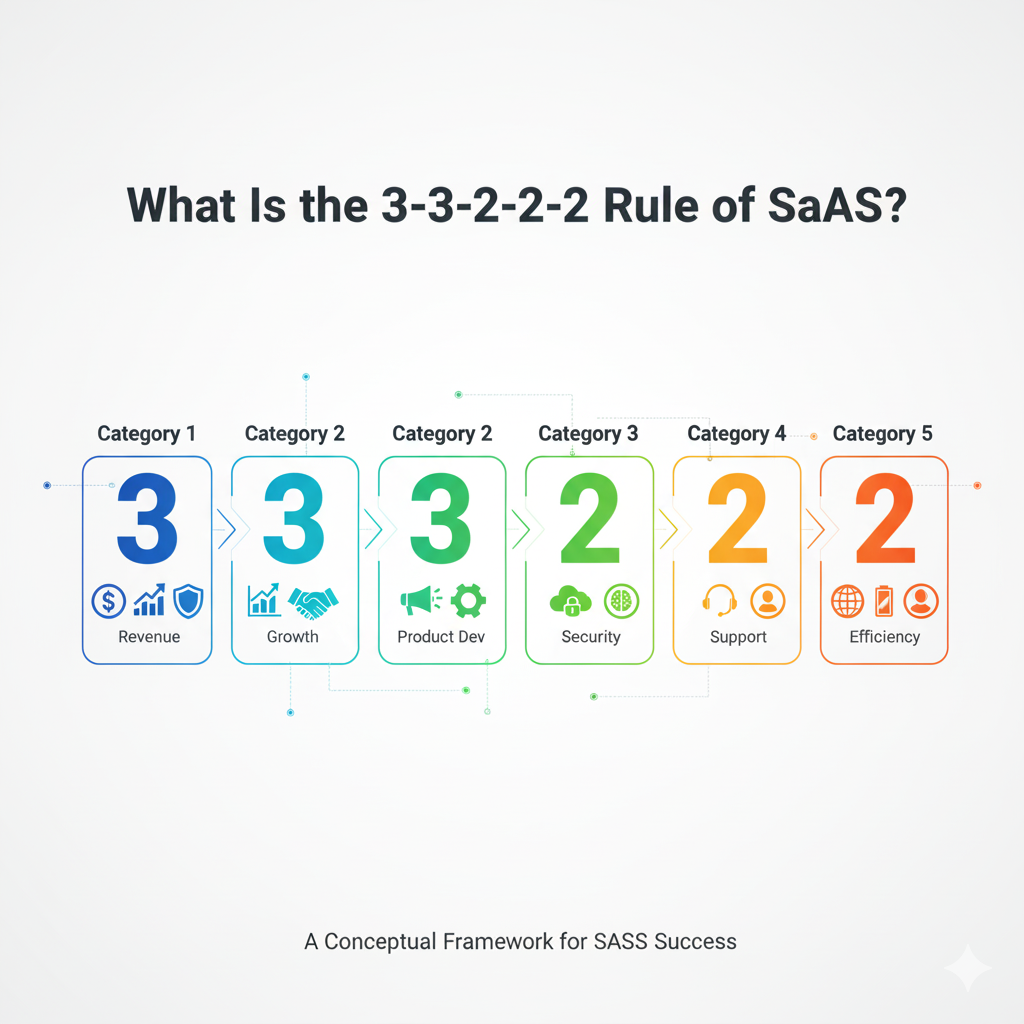
The 3-3-2-2-2 rule is a widely cited growth benchmark for SaaS (Software-as-a-Service) businesses that defines an ideal trajectory for annual recurring revenue (ARR) growth during the first five years after reaching product-market fit.
Here’s the breakdown:
- Year 1: Triple your ARR (3× growth)
- Year 2: Triple again (another 3×)
- Year 3: Double (2×)
- Year 4: Double again (2×)
- Year 5: Double once more (2×)
So it’s 3-3-2-2-2.
For example, if your SaaS starts at $1 M ARR:
- End of Year 1 → $3 M
- End of Year 2 → $9 M
- End of Year 3 → $18 M
- End of Year 4 → $36 M
- End of Year 5 → $72 M
This model originated as a shorthand among venture capital investors to indicate the expected “hyper-growth” curve for high-potential SaaS companies.
Why the 3-3-2-2-2 Rule Matters
1. It’s an Investor Benchmark
For SaaS startups, this rule acts as a quick indicator of whether your company is “venture-scale.” Investors often use it to gauge if a startup has enough growth velocity to justify funding.
2. It Keeps Founders Focused on Growth Phases
Each phase of the rule corresponds to different priorities:
- The triple phases (Years 1-2) → rapid customer acquisition, aggressive marketing, scaling systems.
- The double phases (Years 3-5) → operational optimization, retention, and expansion revenue.
3. It Forces Efficiency
Tripling and doubling revenue requires tight alignment between sales, marketing, product, and customer success. It encourages founders to focus on scalable systems — not just short-term hustle.
4. It Differentiates High-Growth vs Average SaaS
Many SaaS businesses grow 20-40% annually. Hitting the 3-3-2-2-2 curve means you’re among the top 5-10% of high-growth SaaS companies.
5. It Defines the “Startup to Scale-Up” Journey
The rule visualizes how a SaaS evolves from early adoption to maturity — starting with fast exponential growth, then stabilizing into steady doubling.
How to Apply the 3-3-2-2-2 Rule to Your SaaS or Agency
Let’s look at how agencies, freelancers, and small business owners can apply this rule — particularly when using platforms like GoHighLevel to build or manage SaaS products.
Step 1: Establish a Meaningful Baseline
You can’t measure growth unless you have a solid starting point. Typically, this rule applies once you’ve achieved at least $1 M ARR — the point where you’ve proven product-market fit and have predictable customer retention.
If you’re below that, aim for a mini-version: triple your MRR (monthly recurring revenue) twice, then double it in subsequent years.
Breaking Down Each Stage
Year 1: 3× Growth — The Expansion Phase
Goal: Build systems that help you acquire as many new customers as possible without breaking your operations.
Focus on:
- Customer acquisition funnels
- Referral and affiliate marketing (e.g., GoHighLevel affiliate system)
- Automation for lead nurturing
- Building scalable onboarding processes
If you’re using GoHighLevel, its CRM and automation workflows can help you:
- Capture leads automatically
- Nurture them through email/SMS campaigns
- Assign them to sales pipelines
- Onboard new customers at scale
Year 2: 3× Growth Again — The Scale Phase
Goal: Strengthen your growth engine and expand your market reach.
Actions to consider:
- Introduce white-label SaaS mode so clients can sign up directly under your brand.
- Launch targeted ad campaigns to reach new audiences.
- Add upsells and new pricing tiers to increase customer lifetime value (LTV).
- Automate customer support with chatbots and workflows.
Year 3: 2× Growth — The Optimization Phase
Goal: Streamline operations and start maximizing profitability.
What to focus on:
- Improve retention using GoHighLevel CRM data and follow-up automation.
- Optimize churn reduction — small improvements can double your profit.
- Expand into new verticals (real estate, medical, eCommerce).
- Build an affiliate or reseller network for wider reach.
Year 4: 2× Growth — The Maturity Phase
Goal: Sustain growth while improving efficiency.
Tactics:
- Automate as much as possible: onboarding, billing, renewal reminders.
- Focus on customer success and advocacy.
- Use GoHighLevel’s automation and analytics to measure what drives upsells.
- Build community — webinars, tutorials, partner programs.
Year 5: 2× Growth — The Leadership Phase
Goal: You’re now a market leader. Doubling becomes harder but more valuable.
At this stage, your strategy should focus on:
- Retention and expansion revenue
- Partnerships and integrations
- Product innovation
- Financial sustainability (approaching Rule of 40 benchmarks)
Key Metrics to Track
To measure progress against the 3-3-2-2-2 benchmark, focus on:
| Metric | Definition | Target Trend |
|---|---|---|
| ARR / MRR Growth | Annual / Monthly recurring revenue | 3×, 3×, 2×, 2×, 2× |
| Churn Rate | % of customers lost monthly | <5% |
| LTV/CAC Ratio | Lifetime Value vs Customer Acquisition Cost | ≥3:1 |
| Gross Margin | Revenue minus cost of service | ≥75% |
| Net Revenue Retention (NRR) | Expansion revenue minus churn | >120% |
Platforms like GoHighLevel CRM make tracking and automating these metrics easier.
👉 Claim Your GoHighLevel Trial Now 👈
GoHighLevel Features That Support 3-3-2-2-2 Growth
Let’s connect this to the real-world SaaS toolkit — GoHighLevel. It’s an all-in-one sales, CRM, and automation platform that allows agencies and freelancers to launch their own SaaS businesses using its white-label and SaaS mode features.
Here’s how it helps you follow the rule’s growth curve:
| Feature | Benefit |
|---|---|
| GoHighLevel CRM | Centralized client data to manage leads, pipeline, and retention. |
| Automation Builder | Reduces manual work by automating lead nurture, onboarding, and renewal workflows. |
| White-Label SaaS Mode | Lets you rebrand GoHighLevel and sell it under your name. Perfect for agencies turning into SaaS providers. |
| Affiliate System | Encourages word-of-mouth growth through partners. |
| GoHighLevel Pricing | Scalable plans so you can grow your SaaS profit margins as you add users. |
This automation foundation allows you to focus on marketing, upselling, and expansion — the key drivers behind the 3-3-2-2-2 curve.
👉 Claim Your GoHighLevel Trial Now 👈
Example: How an Agency Could Apply the Rule
Let’s say you run a digital marketing agency using GoHighLevel.
- Starting ARR: $200K
- Goal Year 1: $600K (3×)
- Goal Year 2: $1.8M (3×)
- Goal Year 3: $3.6M (2×)
- Goal Year 4: $7.2M (2×)
- Goal Year 5: $14.4M (2×)
You would:
- Launch your white-label SaaS for clients in Year 1.
- Use GoHighLevel automation to handle lead nurturing and onboarding.
- Create a referral/affiliate program for faster expansion.
- In Year 3+, shift from pure acquisition to retention and upselling (e.g., adding advanced automation features).
- Track metrics via GoHighLevel dashboards to ensure you’re on the growth curve.
- 👉 Claim Your GoHighLevel Trial Now 👈
🔥 Set Up GoHighLevel White Label 🔥In Just 1 Day +Get 30 Days Free Trial + Free Live Bootcamp to Launch GoHighLevel SAAS Together
Pros and Cons of the 3-3-2-2-2 Rule
✅ Pros
- Clear growth target: Provides a simple roadmap for scaling.
- Investor confidence: Aligns with venture capital expectations.
- Scalable mindset: Encourages building repeatable, automated processes.
- Focuses on revenue velocity: Keeps founders ambitious and disciplined.
⚠️ Cons
- Aggressive expectations: Not every business can sustain triple growth twice.
- Ignores profitability: Growth may outpace cash flow.
- One-size-fits-all limitation: Works best for companies with solid product-market fit.
- Can cause burnout: Rapid scaling can stretch teams too thin without automation.
The key takeaway: use it as guidance, not gospel. The rule works best when adapted to your market, margins, and resources.
Comparison: 3-3-2-2-2 Rule vs Rule of 40
| Rule | Focus | Formula | Ideal Use Case |
|---|---|---|---|
| 3-3-2-2-2 Rule | Growth velocity | 3×, 3×, 2×, 2×, 2× annual ARR | Early-stage SaaS scaling |
| Rule of 40 | Growth + Profitability | Growth % + Profit % ≥ 40% | Mid-to-late stage SaaS companies |
Use the 3-3-2-2-2 rule to guide early scaling, and shift to the Rule of 40 once growth stabilizes.
👉 Claim Your GoHighLevel Trial Now 👈
Frequently Asked Questions
Q1. What is the purpose of the 3-3-2-2-2 rule?
It’s a growth framework that sets ambitious ARR targets for SaaS companies after reaching product-market fit.
Q2. Is the 3-3-2-2-2 rule realistic for bootstrapped companies?
It can be if you rely on automation, organic marketing, and efficient systems like GoHighLevel. But don’t chase it blindly — adapt it to your cash flow and capacity.
Q3. How long should it take to reach $10 M ARR?
If you start at $1 M and follow 3-3-2-2-2 growth, you could hit $9–10 M in about 2 years.
Q4. What’s the biggest challenge in following this rule?
Maintaining low churn while tripling revenue. Customer success and retention automation are key.
Q5. How does GoHighLevel help with scaling?
It centralizes CRM, marketing, automation, and client onboarding in one place — helping you grow faster without expanding your team proportionally.
👉 Claim Your GoHighLevel Trial Now 👈
Conclusion
The 3-3-2-2-2 rule of SaaS is more than a catchy formula — it’s a powerful growth mindset. It challenges SaaS founders, agencies, and freelancers to think big: triple your ARR twice, then double it three times.
To achieve this kind of scale, you need:
- A solid CRM and automation platform (like GoHighLevel)
- Efficient onboarding and retention systems
- A strong affiliate/referral network
- Smart pricing tiers and white-label opportunities
By combining these tools and principles, you can move from a service-based business to a true SaaS brand with predictable recurring revenue and long-term scalability.
Your journey may not follow the rule exactly — but if it inspires you to focus on sustainable, measurable growth, it’s already done its job.
👉 Claim Your GoHighLevel Trial Now 👈