Introduction
In the rapidly evolving world of customer relationship management (CRM) and marketing automation, businesses often face the challenge of choosing the right platform. Two popular options in this space are Salesforce and HighLevel. While both serve as powerful tools for managing customer interactions and streamlining business processes, they cater to different audiences and offer unique features.
Digital marketing agencies and small business owners, in particular, need to understand what is the difference between Salesforce and HighLevel to make an informed decision that aligns with their operational goals, budget, and scalability needs.
Table of Contents
This article breaks down their features, pricing, pros and cons, and more to help you choose the right solution for your business.
Get 30 Days Free Trial + Free Live Bootcamp to Launch HighLevel Together
Understanding Salesforce and HighLevel
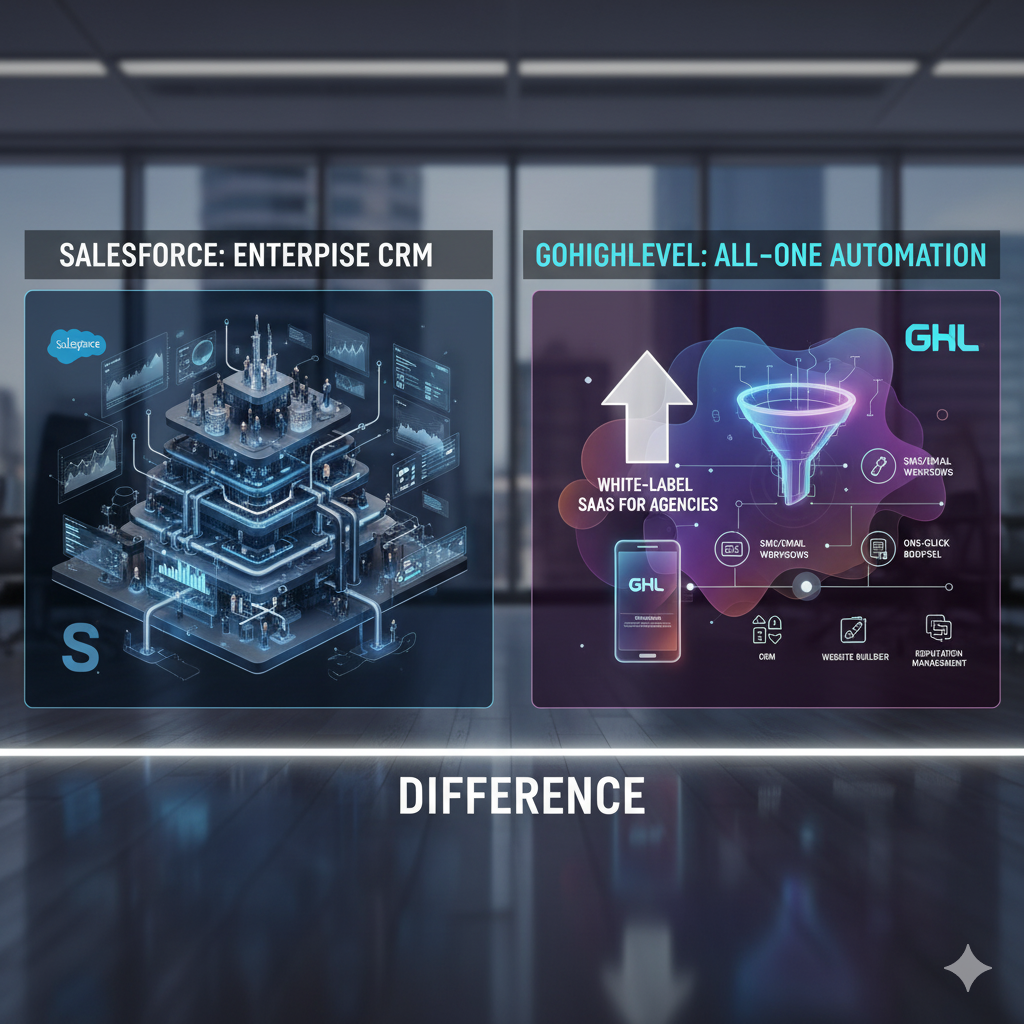
Salesforce is a cloud-based CRM platform widely recognized for its enterprise-level capabilities. It offers a robust suite of tools for sales, customer service, marketing automation, analytics, and more. Salesforce is known for its scalability, customization options, and extensive integrations, making it a top choice for medium to large businesses.
HighLevel (GoHighLevel), on the other hand, is an all-in-one marketing and CRM platform designed specifically for agencies and small business owners. HighLevel combines CRM, marketing automation, lead generation, and white-label SaaS capabilities in a single platform. It is particularly popular among digital marketing agencies seeking to manage multiple clients efficiently while leveraging automation and white-label solutions.
Get 30 Days Free Trial + Free Live Bootcamp to Launch HighLevel Together
Feature Breakdown
To answer what is the difference between Salesforce and HighLevel, let’s examine their key features side by side:
1. CRM and Contact Management
- Salesforce:
Salesforce excels in managing large volumes of contacts and accounts with advanced segmentation, reporting, and pipeline management. It provides tools for tracking interactions, sales history, and customer lifecycle stages. - HighLevel:
HighLevel offers a more simplified CRM designed for lead nurturing and client management. Its contact management is intuitive and integrated directly with marketing automation tools, making it ideal for agencies handling multiple clients.
2. Marketing Automation
- Salesforce:
Salesforce offers Marketing Cloud, a sophisticated automation suite for email campaigns, social media, SMS marketing, and customer journeys. Its automation capabilities are powerful but often require technical expertise to set up. - HighLevel:
HighLevel provides built-in marketing automation, including SMS, email, voice drops, and follow-up sequences. Its workflow builder is user-friendly, allowing agencies to automate campaigns quickly without needing a dedicated developer.
3. White-Label and SaaS Mode
- Salesforce:
Salesforce primarily targets enterprise businesses and does not offer built-in white-label options. Custom branding typically requires additional customization. - HighLevel:
One of HighLevel’s biggest advantages is its white-label functionality, enabling agencies to rebrand the platform and offer it as their own SaaS solution. This is a unique differentiator for agencies looking to generate recurring revenue.
4. Integrations
- Salesforce:
Salesforce boasts thousands of integrations through its AppExchange, including ERP, marketing tools, finance software, and more. This makes it extremely versatile but can also become complex and costly. - HighLevel:
HighLevel includes native integrations for essential marketing tools and CRM functionality. It also supports Zapier and API connections, though its ecosystem is smaller than Salesforce’s.
5. Reporting and Analytics
- Salesforce:
Salesforce is known for its robust analytics and reporting capabilities, offering customizable dashboards, detailed sales metrics, and predictive analytics. - HighLevel:
HighLevel provides reporting dashboards for marketing campaigns, sales pipelines, and client performance metrics. While functional, its analytics are more geared toward agencies rather than enterprise-level forecasting.
Pros and Cons
Salesforce
Pros:
- Highly scalable and suitable for large organizations
- Advanced reporting and analytics
- Extensive integrations with third-party tools
- Highly customizable for complex business processes
Cons:
- Expensive pricing plans
- Steep learning curve for beginners
- Overkill for small businesses or agencies with limited clients
HighLevel
Pros:
- Affordable pricing, especially for agencies
- All-in-one platform (CRM + marketing automation)
- White-label and SaaS capabilities for agencies
- User-friendly and quick to implement
Cons:
- Limited enterprise-level analytics
- Fewer third-party integrations compared to Salesforce
- Less suitable for very large businesses with complex workflows
Pricing Comparison
Understanding pricing is essential when deciding what is the difference between Salesforce and HighLevel:
- Salesforce Pricing:
Salesforce pricing varies widely depending on the product and edition. The Sales Cloud starts at approximately $25/user/month for the Essentials plan and can exceed $300/user/month for the Unlimited plan. Additional costs often apply for advanced features, integrations, and support. - HighLevel Pricing:
HighLevel offers a simplified pricing structure suitable for agencies:- Agency Starter Plan: $97/month (limited features)
- Agency Unlimited Plan: $297/month (full CRM, automation, and white-label SaaS capabilities)
HighLevel provides more value for small businesses and agencies looking to consolidate tools into one platform.
FAQs
1. Is HighLevel better than Salesforce?
It depends on your business needs. HighLevel is ideal for agencies and small businesses seeking an all-in-one, affordable solution. Salesforce is better for large enterprises needing advanced customization, integrations, and analytics.
2. Can HighLevel replace Salesforce?
For small agencies or businesses focused on marketing automation, yes. For complex enterprise-level CRM needs, Salesforce remains unmatched.
3. Does HighLevel offer automation?
Yes. HighLevel provides email, SMS, and workflow automation tailored for agencies and client management.
4. What is the GoHighLevel SaaS mode?
HighLevel SaaS mode allows agencies to rebrand the platform and sell it as their own software, creating recurring revenue streams.
5. How do Salesforce and HighLevel compare in pricing?
HighLevel is significantly more affordable, especially for agencies, while Salesforce pricing scales up quickly with features and user count.
Get 30 Days Free Trial + Free Live Bootcamp to Launch HighLevel Together
Conclusion and Call-to-Action
Choosing the right CRM and marketing automation platform is critical for business growth. While Salesforce offers enterprise-level capabilities with unmatched customization and integrations, HighLevel shines for digital marketing agencies and small business owners seeking an affordable, all-in-one solution with white-label SaaS potential.
Understanding what is the difference between Salesforce and HighLevel can save your business time, money, and resources while helping you achieve better client management and marketing automation results.
If you’re a digital marketing agency or small business owner looking for an all-in-one platform with automation, CRM, and SaaS capabilities, consider exploring HighLevel today and see how it can transform your operations.
Get 30 Days Free Trial + Free Live Bootcamp to Launch HighLevel Together