
Introduction
If you’re a digital marketing agency, freelancer or small business owner looking to streamline your tech stack, you’ve probably come across two standout platforms: GoHighLevel (often simply “HighLevel”) and HubSpot. In the “HighLevel vs HubSpot” debate, each has its strengths—and the right choice depends heavily on your business model, budget, and goals.
Because I work extensively in SaaS, agency operations and automation, I’ve seen first‑hand how different tools either simplify or complicate processes. This article will provide a deep dive into both platforms—covering features, automation capabilities, CRM functionality, SaaS/white label options, pricing, pros & cons, and a final recommendation. If you’re considering automating more of your offerings, building a SaaS, or reorganising your agency platform stack, this comparison is for you.
Let’s get started.
Table of Contents
What Are They?
GoHighLevel
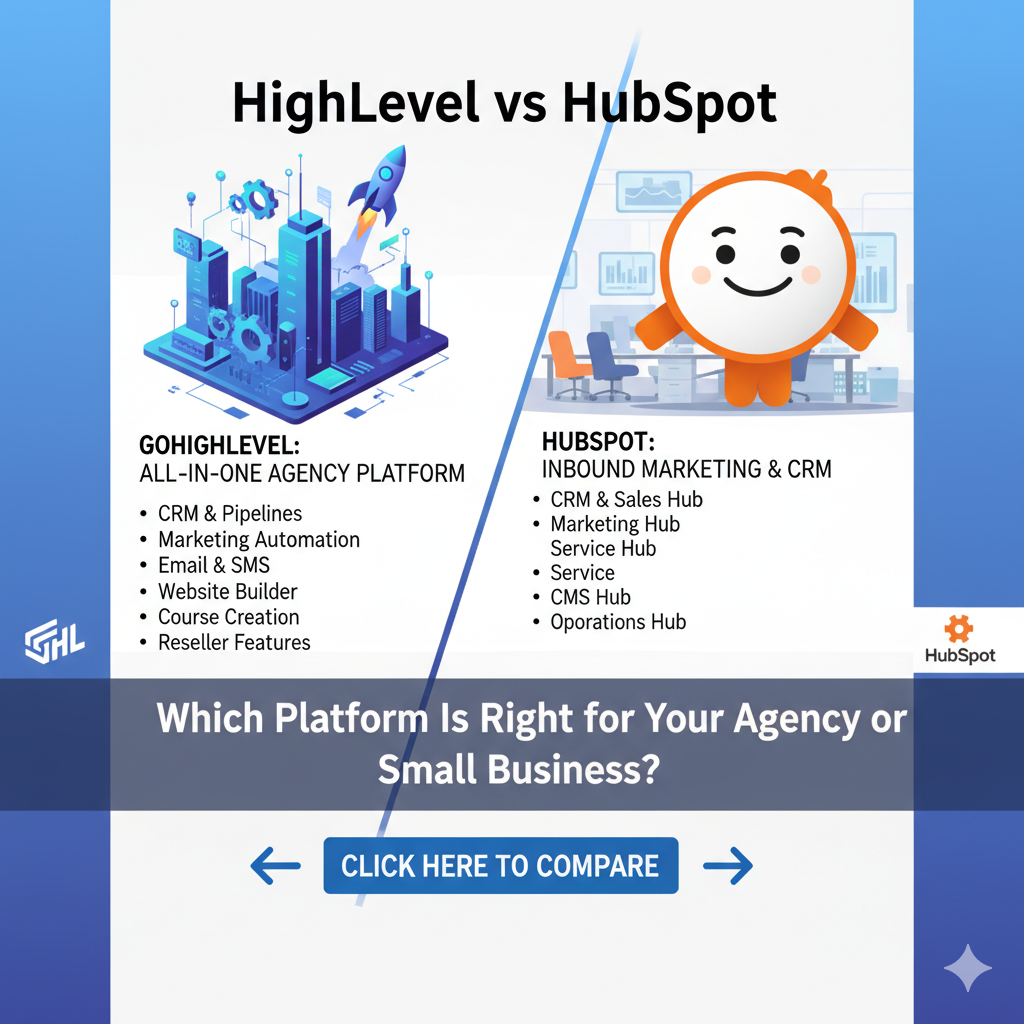
GoHighLevel is an all‑in‑one platform designed primarily for agencies and service‑based businesses. It includes CRM, funnel builder, SMS/email/voicemail automation, appointment/scheduling tools, reputation management, and crucially a white‑label/SaaS mode for agencies to resell the platform under their branding.
Key keywords tied to GoHighLevel: GoHighLevel pricing, GoHighLevel affiliate, GoHighLevel automation, GoHighLevel SaaS mode, GoHighLevel white label, GoHighLevel CRM.
HubSpot
HubSpot is one of the more established players in the CRM + inbound marketing + sales + service space. It offers a free CRM tier, and then various hubs (Marketing, Sales, Service, CMS, etc.) that scale up. It’s well‑suited for businesses that prioritise inbound methodology, content marketing, and have resources for more advanced systems.
So the central question: which is the better fit for you?
Feature Breakdown
Below is a detailed comparison of features across key dimensions.
CRM & Contact/Lead Management
- GoHighLevel: Offers contact management, pipeline stages, custom fields, lead scoring and multi‑client (agency) account views via “agency snapshots”.
- HubSpot: Offers robust CRM functionality, deal tracking, task management, integration with email/inbox/calendar, and seamless onboarding via its free tier.
Verdict: Both handle CRM well; HubSpot wins on polish and ease of use; HighLevel wins if you need agency‑centric multi‑client architecture.
Marketing & Sales Automation
- GoHighLevel: Strong in automation for agencies—email, SMS, voicemail drops, appointment reminders, funnels, triggers.
- HubSpot: Offers advanced workflows, conditional logic, predictive lead scoring, extensive integrations, strong automation in marketing, sales and service.
Verdict: If you’re focussed on heavy‑duty automation and multichannel (SMS + voice + email) especially for service businesses, HighLevel has a niche. If you want mature workflows, advanced segmentation, enterprise scalability, HubSpot leads.
SaaS Mode / White Label / Agency Capability
- GoHighLevel: One of its key differentiators is the ability for agencies to white‑label the platform, set their own pricing, manage sub‑accounts and essentially build a SaaS offering.
- HubSpot: While it offers partner programmes and an ecosystem, it is not designed primarily for agencies to resell it as a white-label SaaS product; it’s more of a platform you adopt.
Verdict: If your business model is agency + reselling + white label + building your own SaaS, GoHighLevel is built for that. HubSpot is more of a tool you adopt.
Pricing & Value
- GoHighLevel: The pricing model emphasises unlimited users/contacts/client accounts in many plans, predictable cost.
- HubSpot: Offers a generous free CRM tier. But for more advanced features (automation, multiple hubs, large contacts) pricing rises substantially.
Verdict: For smaller budgets or agencies managing multiple clients under one roof, GoHighLevel may provide stronger value. For businesses focussed on inbound content + growth with capacity for higher spend, HubSpot is reasonable—but cost scales fast.
Integrations, Ecosystem & Community
- HubSpot: Very strong ecosystem, large marketplace of integrations, strong training resources (HubSpot Academy) and community.
- GoHighLevel: While improving, some user-feedback shows less polish, fewer integrations compared to HubSpot.
Verdict: If integrations across many third-party tools and ecosystem maturity matter, HubSpot has the edge. If you prioritise core all‑in‑one and fewer moving parts, HighLevel may suffice. - 🚀 Try GoHighLevel 14 Days Free Trial Here
Reporting & Analytics
- HubSpot: Strong built‑in reporting and analytics dashboards across hubs; mature.
- GoHighLevel: Good for basic reports and agency dashboards, but some reviews highlight limitations compared to mature CRM/MarTech stacks.
Verdict: HubSpot for advanced analytics; HighLevel for simpler/agency‑oriented reporting.
The Pros & Cons
GoHighLevel Pros
- Designed for agencies & service‑businesses: white‑label SaaS, agency account management, multi‑client views.
- Predictable pricing, often unlimited users/contacts in many plans.
- Extensive automation capabilities (SMS, voicemail, email, funnel + landing page builder).
- Opportunity to build your own SaaS/reseller business.
GoHighLevel Cons
- Learning curve: because it’s packed with features, new users may feel overwhelmed.
- Interface/user‑experience may not be as polished as mature platforms.
- Some integrations/third‑party ecosystem may be less mature than HubSpot’s.
- If your business is not agency‑centric or SaaS‑centric, you may not need everything it offers.
HubSpot Pros
- Very polished interface, strong ease‑of‑use, very large ecosystem of integrations.
- Free CRM tier to begin, which is generous for small teams.
- Broad feature set across marketing, sales, service—ideal for inbound strategy and full‑funnel management.
- Strong brand, community and training (HubSpot Academy).
HubSpot Cons
- Cost can escalate quickly as you add contacts/users/hubs/modules.
- For agencies wanting to white‑label or resell platform, it’s not built for that in the same way HighLevel is.
- Some features are “breadth over depth”—very wide feature set, but maybe more complexity than needed for smaller teams.
Pricing Comparison
Here’s a simplified pricing overview. Always check the vendor for latest pricing, as it can vary by region/contacts/features.
- GoHighLevel: Starts at around US $97/month for a basic plan and goes to higher tier “Agency Unlimited” around US $297/month.
- HubSpot: Free CRM tier; paid tiers vary widely. For example, Sales Hub Starter might be US $15/user/month, Professional US $90+/user/month, and Marketing/Service Hubs much more. Costs can quickly escalate to hundreds/thousands per month.
Summary: If you’re an agency handling multiple clients and want one platform, GoHighLevel may provide higher value for your cost. If you’re a business with a lower number of users and can afford scaling costs, HubSpot is viable.
Which Platform for Which Use‑Case?
Here are ideal scenarios for each platform:
- Choose GoHighLevel if:
- You run a digital marketing agency and manage multiple clients/sub‑accounts.
- You are building a SaaS or white label offering and want to resell.
- You need multichannel automation (SMS, voicemail, email) and want predictable pricing.
- You want one unified platform rather than many point tools.
- Choose HubSpot if:
- You are a small to medium business focused on inbound marketing, content creation, and growth.
- You want a very polished, ease‑of‑use system with large ecosystem/integrations.
- You don’t need to white‑label or resell the platform.
- You’re comfortable with a pricing model that scales with usage/features.
- 🚀 Try GoHighLevel 14 Days Free Trial Here
FAQs
Q: Is GoHighLevel just for agencies?
A: While GoHighLevel is built with agencies in mind, it can also be used by freelancers or small businesses.
Q: Can HubSpot replace all tools (email marketing, SMS, funnels)?
A: HubSpot is strong in email marketing, inbound, CRM and sales/service workflows, but may require additional integrations for SMS or voicemail automation.
Q: What about “GoHighLevel affiliate”?
A: GoHighLevel has an affiliate programme allowing you to earn commissions by referring clients.
Q: How does SaaS mode work in GoHighLevel?
A: Agencies can take the platform, re‑brand it (white‑label), set their own pricing, manage client accounts, and offer a SaaS solution built on GoHighLevel.
Q: Which has better automation features?
A: Both are strong. HubSpot offers advanced automation; GoHighLevel offers excellent multichannel automation for agency-use cases.
Conclusion
In the “HighLevel vs HubSpot” decision, the right choice comes down to your business model and what you prioritise. If you’re an agency or service provider looking to consolidate tools, deliver to multiple clients, and build a white‑label offering, GoHighLevel stands out. If you’re a business focused on inbound growth, content, integration with many tools, and are comfortable with scaling spend, HubSpot is a compelling option.
- Recommendation:
- Agencies with multiple clients, SaaS ambitions, or need multichannel automation → GoHighLevel.
- Growing businesses with inbound focus, integration needs, and higher budgets → HubSpot.